Trend report 2026–2027 · Free PDF · About 15 min read

5 trends reshaping employee communications forever

Internal communication has long worked like a feed. The next step is flow: how quickly someone can find the right answer, understand it and act on it.

Five places where that flow tends to break—each with a question worth asking and where we'd start:

  • Get your knowledge ready for AI—start with 50–200 well-kept routines, not the whole intranet.
  • Give managers a brief that works in a five-minute huddle, not a meeting room.
  • Show leadership five levels from opened to impact, not just open rates.
Get the guide

For communicators and communication managers—especially in organisations where many people don't work at a desk.

Free PDF · 11 pages · English. By Daniel Hagenfeldt, Founder and CEO of Spintr. Draws on Gallup, Gallagher, Quinyx and more—sources listed in the guide.

Fill in the form and it's yours straight away—we'll email you the link too. See what's inside

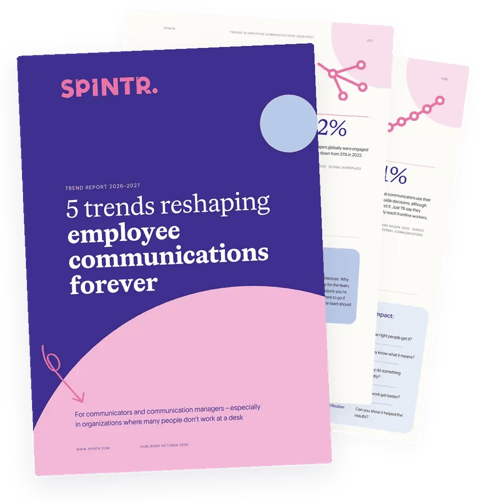
Spintr's trend report 5 trends reshaping employee communications forever, 2026–2027: the cover in front of two inside pages.

Who it's for

For professional communicators and communication managers

If you run communication day to day

  • A “worth asking” question for each shift, to take to your team
  • What goes into a good manager brief
  • “Where we'd start”: four concrete first steps per shift

If you lead communications

  • Five levels from opened to impact, to show leadership what communication changes
  • What the EU AI Act means for an AI assistant—and when the rules apply
  • “If I had to pick three”: where to focus first in 2027

Spintr is the intranet for organisations where many people don't work at a computer. We made this report as input for your next planning round—not a finished answer.

From the guide

Two ideas you can use straight away

1. Worth asking

How long does it take a manager to turn your last update into a team briefing?

Managers should add meaning, not control access to information. The guide spells out what goes into a good manager brief: what's happening in two sentences, why, what changes for the team and what doesn't—plus the three questions they're likely to get.

2. From opened to impact: five levels

  1. Reached
  2. Understood
  3. Acted
  4. Operations
  5. Contribution

Open rates tell you something was opened. Not much more. The guide gives you one question per level—from “Did the right people get it?” to “Can you show it helped the results?”
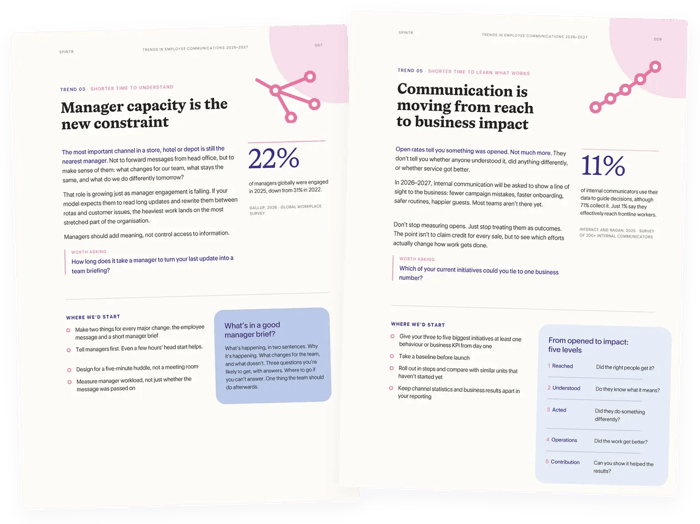
Pages 7 and 9 of the guide: the manager-capacity chapter with what goes into a good manager brief, and the five levels from opened to impact.

Pages 7 and 9 of the guide. Written by Daniel Hagenfeldt, Spintr. Sources are listed in the guide.

What's inside

The five trend shifts at a glance

Each shift comes with a time worth shortening, a question worth asking and four concrete places to start.

  1. 01

    Page 5 · Shorter time to answer

    AI is transforming information consumption

    Answers move closer to the work, so the knowledge must hold up.

  2. 02

    Page 6 · Shorter time to find

    Fragmented channels are slowing the frontline down

    One obvious place to start matters more than one big system.

  3. 03

    Page 7 · Shorter time to understand

    Manager capacity is the new constraint

    Managers add meaning, so give them material that works in a five-minute huddle.

  4. 04

    Page 8 · Shorter time to correct

    Frontline feedback is becoming an operational signal

    The frontline sees problems first, as long as the loop back is closed.

  5. 05

    Page 9 · Shorter time to learn what works

    Communication is moving from reach to business impact

    Opens show exposure, not understanding or action.

Design the comms flow, not just the feed

The common thread in these five shifts isn't technology. It's friction. Eleven pages with the questions worth asking and where to start. Free PDF · English.

Get the guide